-
 Call Now ! +2348033205357
 -
 Email Now [email protected]

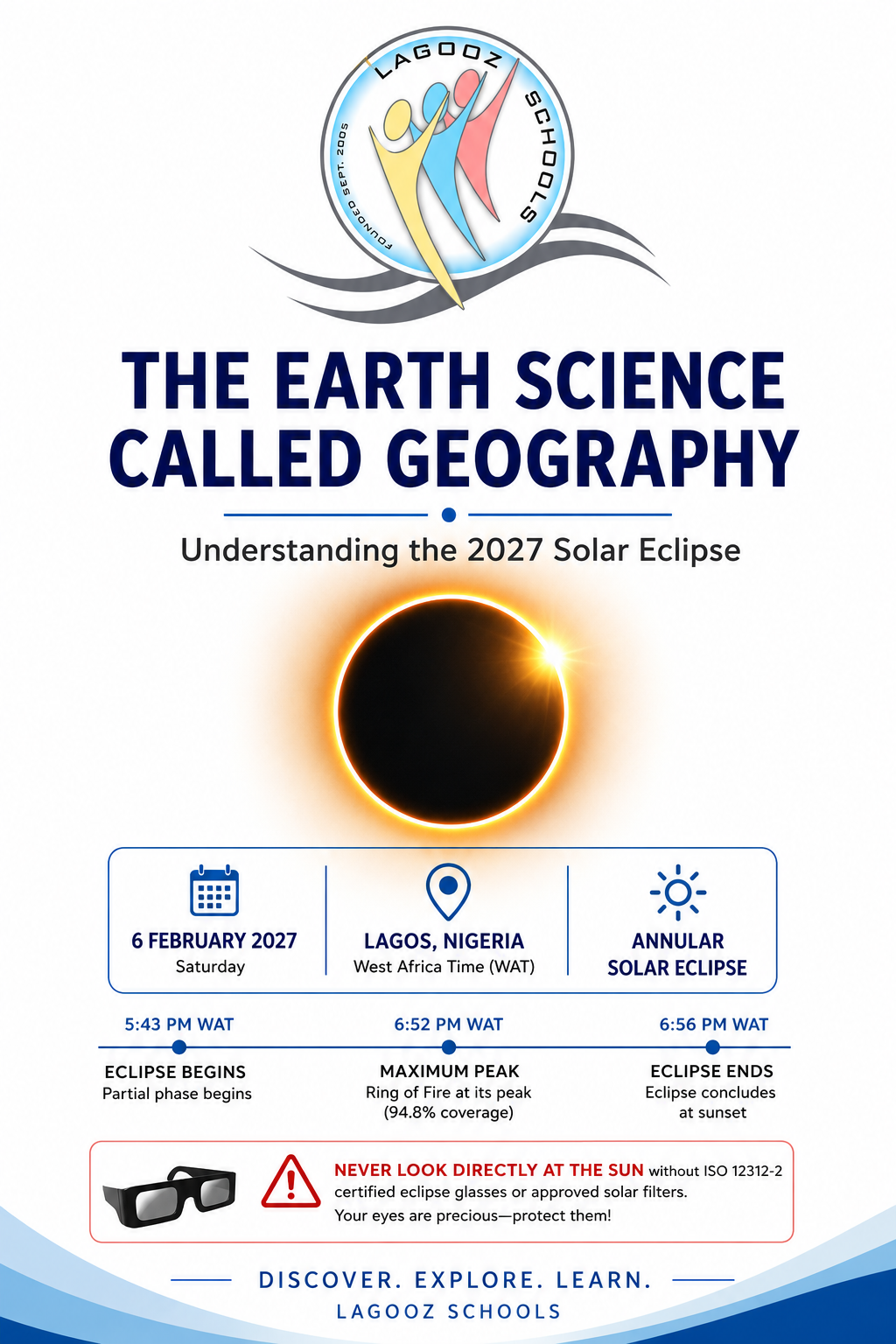
A solar eclipse is one of nature’s most fascinating astronomical events. It occurs when the Moon passes between the Earth and the Sun, temporarily blocking the Sun’s light. This remarkable alignment happens because, although the Sun is about 400 times larger than the Moon, it is also nearly 400 times farther away, making both appear almost the same size from Earth.
There are three main types of solar eclipses: Total, Annular, and Partial. During a Total Solar Eclipse, the Moon completely covers the Sun. In an Annular Solar Eclipse, the Moon appears slightly smaller, leaving a bright “Ring of Fire” around the Sun. A Partial Solar Eclipse occurs when only part of the Sun is covered.
On Saturday, 6 February 2027, residents of Lagos, Nigeria, will witness an Annular Solar Eclipse. The eclipse will begin at 5:43 PM (WAT), reach its maximum at 6:52 PM, and end at 6:56 PM, lasting about 1 hour and 13 minutes. At its peak, the Moon will cover approximately 94.8% of the Sun, creating the spectacular ring effect.
Safety is essential during this event. Never look directly at the Sun without ISO 12312-2 certified eclipse glasses or approved solar filters. Ordinary sunglasses are not safe and can cause permanent eye damage.
At Lagooz Schools, we believe geography and science help students understand the wonders of our world and the universe beyond it. Events like the 2027 solar eclipse inspire curiosity, scientific thinking, and a lifelong passion for learning.
Comments
No comment added yet